

 |
(AFP/Yonhap) |
<이미지를 클릭하시면 크게 보실 수 있습니다> |
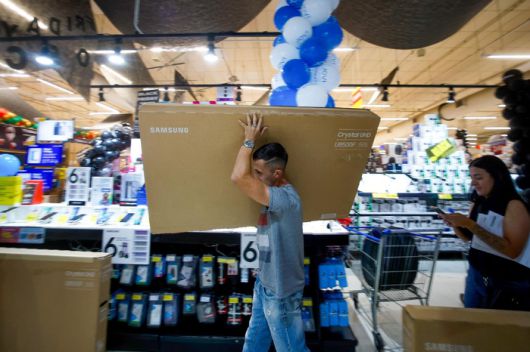
Samsung Electronics Co. and LG Electronics Inc. maintained their lead in the global TV market in the third quarter, even as Chinese TV makers accelerated their growth.
According to market research firm Omdia on Sunday, Samsung ranked first in both revenue and shipments during the third quarter. Its revenue share rose to 29 percent from 28.6 percent a year earlier.
LG’s revenue share declined slightly from 16.5 percent to 15.2 percent, but it held onto second place. TCL Technology Group Corp. and Hisense Group Co. followed at 13 percent and 10.9 percent, respectively.
The strong performance of Samsung and LG reflects their dominance in the premium segment.
Samsung accounted for 53.1 percent of revenue in TVs priced above $2,500 and retained the top spot in the 75-inch and larger category with a 29.1 percent share.
LG led the OLED TV segment, capturing 49.7 percent of shipments and 45.4 percent of revenue. Samsung’s OLED TV revenue reached 34.9 percent.
If current trends continue, Samsung is on track to remain the global TV market leader for more than 20 consecutive years, while LG would extend its streak as the top OLED TV seller for 13 straight years.
Shipment data, in the meantime, shows Chinese brands are catching up.
Third-quarter shipment shares were 17.9 percent for Samsung, 14.3 percent for TCL, 12.4 percent for Hisense and 10.6 percent for LG. The gap between Samsung and TCL has narrowed.
Chinese companies accounted for a combined 31.8 percent of shipments, surpassing the 28.5 percent held by Korean brands.
The rise of Chinese market share is partly due to a shrinking global TV market.
With overall demand weakening, cheaper products are performing better.
TrendForce reported that third-quarter global TV shipments fell 4.9 percent year-on-year to 49.75 million units, marking the first time third-quarter shipments fell below 50 million. Sigmaintell, a Chinese research firm, said global TV shipments peaked at 250 million units during the 2020 pandemic but dropped to 216.7 million this year, with further declines expected through 2028.
Both Samsung and LG are estimated to have posted losses in their TV businesses in the third quarter.
In response, they are reorganizing and expanding their platform strategies such as by developing TV operating systems that can be sold to external partners or used to generate advertising revenue.
LG recently merged its TV and IT units into a new Display Business division and established a Display Product Development Group to focus on growth categories such as gaming monitors.
The company also elevated its webOS advertising unit, promoting Cho Byung-ha, head of the webOS Platform Business Center, to executive vice president as part of its plan to expand the OS business.
Samsung promoted Kim Moon-soo, who leads software commercialization development in the VD Division, to corporate vice president. Kim has overseen development of Tizen, Samsung’s TV operating system.
“Building an in-house OS has become a global trend among TV makers,” said Kim Jo-han, co-founder of digital platform company New ID.
He cited Vizio, acquired by Walmart, which uses its own SmartCast, and China’s Hisense, which operates its own Vidaa.
Samsung is also expanding its OLED TV business, increasing sales of models equipped with LG Display panels. Recent prices for 55-inch OLED TVs in Korea have fallen to the low 1-million-won ($680) range.
이 기사의 카테고리는 언론사의 분류를 따릅니다.
기사가 속한 카테고리는 언론사가 분류합니다.
언론사는 한 기사를 두 개 이상의 카테고리로 분류할 수 있습니다.
언론사는 한 기사를 두 개 이상의 카테고리로 분류할 수 있습니다.
