

 |
(PPCA) |
<이미지를 클릭하시면 크게 보실 수 있습니다> |
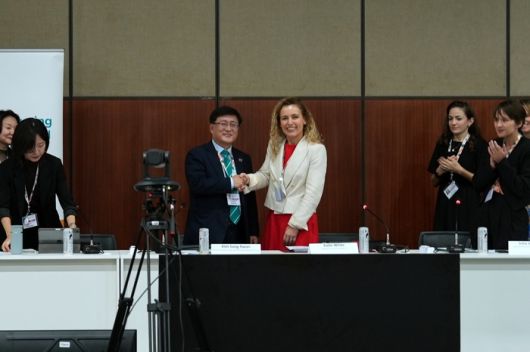
South Korea has become the second country in Asia to join the Powering Past Coal Alliance (PPCA).
The Ministry of Climate, Energy and Environment announced on Tuesday that it declared its intent to join the PPCA during the 30th Conference of the Parties (COP30) to the UN Framework Convention on Climate Change, which took place in Belém, Brazil.
The PPCA aims to achieve the phased withdrawal of coal-fired power generation, with participation of more than 60 countries including the United States and the United Kingdom and over 180 institutions.
Korea is the second Asian country to join after Singapore.
While Singapore does not operate coal-fired power plants, Korea currently ranks seventh in the world in coal-fired power generation capacity.
Upon joining the PPCA, the Korean government pledged not to build any new coal-fired power plants without greenhouse gas reduction facilities.
It also decided to close 40 of the country’s coal-fired plants currently in operation by 2040 as originally planned, with the fate of the remaining 21 plants to be decided by next year following a public deliberation process, the ministry said.
With Korea’s accession to the PPCA, the government’s upcoming 12th Basic Plan for Long-term Electricity Supply and Demand, which is scheduled to be released next year, is expected to include a more forward-looking coal phaseout roadmap.
In its current 11th plan, the government outlined a policy to shut down 28 aging coal plants by 2036 and convert them to liquefied natural gas (LNG) power generation.
It also planned to decommission an additional 12 aging coal plants and replaced them with carbon-free power sources such as pumped-storage hydropower, hydrogen-exclusive combustion, and ammonia co-firing from 2037 to 2038.
“Our goal is to hold a kickoff meeting for drafting the 12th power plan within the year,” said a climate ministry official. “Any changes to the coal phaseout roadmap established in the 11th plan will depend on factors such as increased renewable capacity and projected power demand.”
Industry experts, meanwhile, caution that the government must design a roadmap based on realistic feasibility.
“It may be possible to close 40 coal-fired units by 2040, but the government must comprehensively examine whether the public can bear the cost burden and whether the domestic power supply will remain stable,” said Lee Sang-jun, professor of energy policy at Seoul National University of Science and Technology. “A coal phaseout roadmap, even if created, may fail to function properly. Serious discussion is essential.”
이 기사의 카테고리는 언론사의 분류를 따릅니다.
기사가 속한 카테고리는 언론사가 분류합니다.
언론사는 한 기사를 두 개 이상의 카테고리로 분류할 수 있습니다.
언론사는 한 기사를 두 개 이상의 카테고리로 분류할 수 있습니다.
