

 |
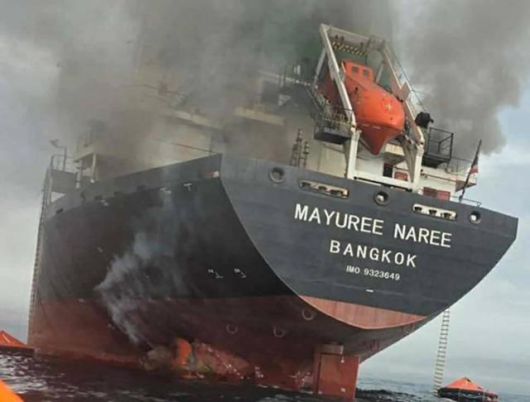
A handout photo made available by the Royal Thai Navy shows the Thai-flagged cargo ship Mayuree Naree on fire after being hit by Iranian missiles in the Strait of Hormuz, Iran, Mar. 11, 2026. According to the Royal Thai Navy, 20 Thai crew members were rescued by Oman's navy while three remain missing. EPA-Yonhap |
<이미지를 클릭하시면 크게 보실 수 있습니다> |
Posting on his social media platform Truth Social, Trump called on South Korea, the United Kingdom, France, Japan and China — along with other countries dependent on the strait’s oil flows — to dispatch warships to help restore shipping traffic through the narrow waterway.
The appeal came after Iran effectively closed the Strait of Hormuz in retaliation for U.S. and Israeli airstrikes, triggering what analysts describe as one of the largest disruptions to global oil supplies in modern history.
The request underscores both the strategic importance of the strait and the growing costs facing Washington as the war with Tehran stretches into its third week, with potentially severe consequences for the global and U.S. economies.
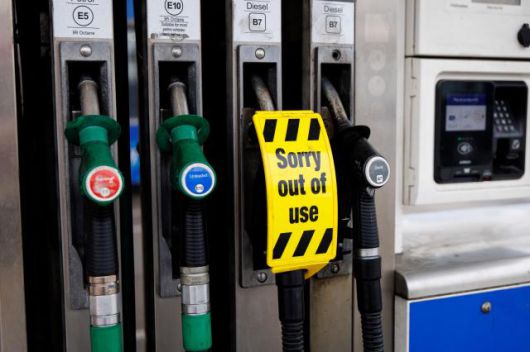 |
Unleaded and diesel fuel pumps at a petrol station forecourt in London, Britain, Mar. 13, 2026. Disruptions to oil shipping routes due to the closure of the Strait of Hormuz in the wake of US and Israeli military strikes on Iran and retaliatory attacks by Iran have led to a surge in fuel prices at UK petrol stations. Economists warn that this increase could raise inflation and reduce consumer spending. EPA-Yonhap |
<이미지를 클릭하시면 크게 보실 수 있습니다> |
For Trump, the logic behind the request appears straightforward: the countries he named include some of the world’s largest naval powers and major beneficiaries of open sea lanes.
“The countries named are the leading naval powers after the United States and among the major beneficiaries of open sea lanes,” said Harvey M. Sapolsky of the Massachusetts Institute of Technology.
Some analysts say Trump’s reasoning is consistent with his business-minded approach to geopolitical and diplomatic issues, emphasizing burden-sharing and clear responsibilities.
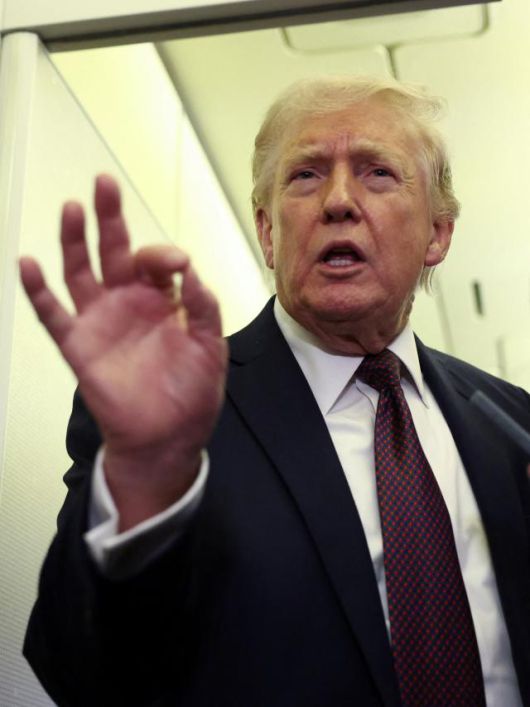 |
U.S. President Donald Trump speaks to reporters aboard Air Force One on a flight back to Washington Mar. 15, 2026. Reuters-Yonhap |
<이미지를 클릭하시면 크게 보실 수 있습니다> |
“If there’s no response or if it’s a negative response, I think it will be very bad for the future of NATO,” Trump told the Financial Times on Sunday.
In the interview, Trump also suggested that China should send warships to help secure the Gulf and warned that he could postpone a summit scheduled for early April in Beijing with Chinese President Xi Jinping if China did not comply.
“The United States seems to have come to the realization that its conflict with Iran will require more assistance and resources than Washington anticipated,” Tan said.
“These countries are all major users of the Strait of Hormuz, so keeping it open serves their interests as well.”
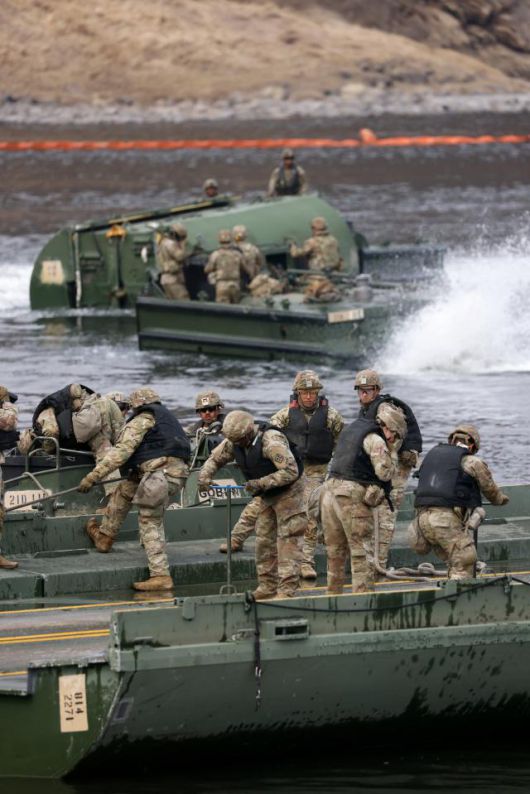 |
U.S. Army soldiers take part in a U.S.-South Korea joint river-crossing exercise, which is a part of the annual Freedom Shield joint military training, near the demilitarized zone separating South and North Korea, in Yeoncheon, South Korea, Mar. 14, 2026. Reuters-Yonhap |
<이미지를 클릭하시면 크게 보실 수 있습니다> |
Alan Chong Chia Siong, also of Nanyang Technological University, said the U.S. president may be probing what he sees as a group of “new strategic friends” outside traditional alliance structures.
Still, many analysts remain skeptical of the coalition idea, noting that it could draw third countries directly into the conflict and potentially widen the war.
The Strait of Hormuz is now effectively an active war zone, where Iranian forces have threatened attacks on vessels linked to the United States or Israel. Deploying naval escorts could significantly increase the risk of confrontation.
“Operating in these waters is extremely risky at present,” said Yang Zi of Nanyang Technological University.
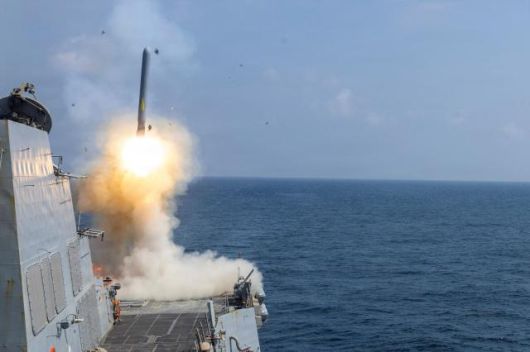 |
The U.S. Navy Arleigh Burke-class guided-missile destroyer USS Delbert D. Black fires a Tomahawk Land Attack Missile (TLAM) in support of the Operation Epic Fury attack on Iran from an undisclosed location Feb. 28, 2026. Reuters-Yonhap |
<이미지를 클릭하시면 크게 보실 수 있습니다> |
Legal experts also point to significant international law questions.
Mara Revkin of Duke University School of Law noted that economic interests alone do not justify the use of military force under the UN Charter.
Article 2(4) of the charter prohibits the use of force against other states except in cases of self-defense or when authorized by the UN Security Council.
While escorting commercial ships through international waters is generally lawful, Revkin said the situation becomes far more complicated in an active war zone.
“Any naval deployment by a third-party state — even if intended to protect commercial shipping — could risk being perceived by Iran as entering the conflict,” she said.
Beyond the immediate question of naval escorts lies a broader uncertainty: how the war itself will unfold.
Many analysts believe the conflict could become prolonged. Iran, they argue, is likely to continue exerting pressure on the Strait of Hormuz as leverage in future negotiations.
Barry R. Posen of MIT predicts that the war could ultimately end with both sides claiming victory, even if Iran’s military infrastructure suffers heavy damage.
Washington may also have underestimated Iran’s resilience, said Paul Michael Hedges of Nanyang Technological University, noting that Tehran has remained defiant even after the killing of its longtime leader.
If maritime disruptions continue, the United States could face mounting pressure to deploy ground forces to secure key areas around the Persian Gulf — an escalation that risks turning the conflict into a prolonged and politically costly war.
Lee Jung-woo Reporter cannes2030@ajupress.com
- Copyright ⓒ [아주경제 ajunews.com] 무단전재 배포금지 -
이 기사의 카테고리는 언론사의 분류를 따릅니다.
언론사는 한 기사를 두 개 이상의 카테고리로 분류할 수 있습니다.
