

 |
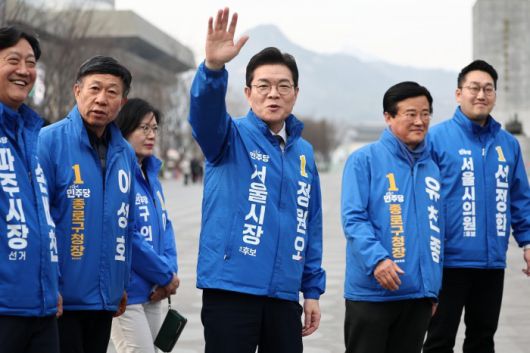
Preliminary candidate Jung Won-oh greeted citizens at Gwanghwamun Square in Seoul on March 24, the final day of the Democratic Party’s mayoral primary voting. / Yonhap News |
<이미지를 클릭하시면 크게 보실 수 있습니다> |
Infighting within South Korea’s ruling Democratic Party of Korea is intensifying ahead of the June 3 local elections, as candidates fiercely compete for nominations widely seen as a ticket to victory.
With the party enjoying high approval ratings, expectations that securing the nomination virtually guarantees election success have heightened competition, particularly in key battlegrounds such as Seoul, Gyeonggi Province, and the Gwangju–South Jeolla region. The escalating rivalry has also led to an increase in negative campaigning among candidates.
According to political sources on March 24, competition among candidates vying for gubernatorial and mayoral nominations has grown increasingly heated, with internal disputes spilling into public attacks.
In the closely watched Seoul mayoral primary, candidates have stepped up criticism of one another. Rival contenders have particularly targeted Jung Won-oh, who is considered a potential “Lee Jae-myung pick” and has been leading in recent polls.
Rep. Park Joo-min criticized Jung during a recent debate, raising questions about alleged sponsorship ties with Deutsche Motors and saying, “He lacks the moral sensitivity expected of an elected Democratic Party official.” Jung faces allegations that, during his tenure as Seongdong District mayor, he accepted sponsorship from the company, which has been linked to stock manipulation allegations involving First Lady Kim Keon-hee.
On the same day, candidate Jeon Hyun-hee criticized Jung’s free public shuttle bus policy, calling it “no different from Seoul Mayor Oh Se-hoon’s river bus—an example of wasteful spending and showy administration.” Candidate Kim Young-bae also warned that the primary should not devolve into a mere popularity contest.
Experts say such negative tactics are often used by candidates under pressure. Kim Cheol-hyun, a special professor at Kyungil University, noted that while Park and Jeon are well-known national figures, they have intensified their attacks as Jung’s rapid rise and strong poll numbers threaten their positions.
A similar pattern is unfolding in the Gyeonggi gubernatorial primary. Leading contenders, including Kim Dong-yeon, Choo Mi-ae, and Han Jun-ho, are increasingly engaged in factional disputes rather than policy debates.
Criticism has been particularly directed at incumbent Governor Kim Dong-yeon, with opponents arguing that his policies do not align with the party’s core identity. Han Jun-ho said, “Looking at Governor Kim’s policies, values such as universal welfare and the basic society envisioned by the president have largely disappeared.”
Concerns are also growing within the party that escalating negativity could undermine its internal discipline. A first-term lawmaker from the party warned, “As time goes on, negative campaigning in the primary process is intensifying. With the party’s approval ratings high, some candidates appear to be losing their ability to self-regulate, which is worrying.”
ⓒ "젊은 파워, 모바일 넘버원 아시아투데이"
이 기사의 카테고리는 언론사의 분류를 따릅니다.
기사가 속한 카테고리는 언론사가 분류합니다.
언론사는 한 기사를 두 개 이상의 카테고리로 분류할 수 있습니다.
언론사는 한 기사를 두 개 이상의 카테고리로 분류할 수 있습니다.
