

 |
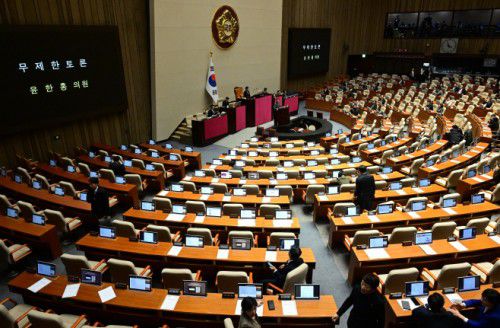
Rep. Yoon Han-hong of the People Power Party speaks during a filibuster on a revised Commercial Act bill at a plenary session of the National Assembly on Feb. 24. /Lee Byung-hwa |
The ruling Democratic Party’s push for sweeping judicial reform is gaining momentum, with three key bills expected to be introduced at the National Assembly plenary session between Feb. 24 and the end of the extraordinary session on March 3.
The so-called “judicial reform trio” — the distortion of law offense, the constitutional complaint system on court rulings and a bill to increase the number of Supreme Court justices — could pass as early as Feb. 25, beginning with the distortion of law measure. Although the opposition has attempted to stall proceedings through a filibuster over a separate Commercial Act revision, the ruling party is expected to advance the bills sequentially once the debate concludes.
Under the proposed distortion of law offense, judges and prosecutors could face criminal punishment if they are found to have intentionally distorted the law or misjudged facts during trials or investigations. Critics argue that the standards for punishment remain unclear, raising concerns that vague criteria could leave judicial officials vulnerable to politically motivated prosecution.
Opposition lawmakers contend that the bills reflect an attempt by the ruling party to subordinate the judiciary to elected power. With the Democratic Party holding 166 seats — a parliamentary majority — passage of the legislation appears likely. If approved by a majority of registered lawmakers present and a majority of those voting, the president must promulgate the bills within 15 days.
As the reform drive intensifies, the Supreme Court of Korea has convened an emergency meeting of chief judges nationwide to gather opinions. The meeting is scheduled for Feb. 25. During a similar gathering in December, concerns were raised over the constitutionality of introducing the distortion of law offense.
Chief Justice Cho Hee-dae publicly expressed opposition on Feb. 23, saying the bills contain “grave matters that could amount to constitutional amendments and directly affect the public.”
Legal scholars have also voiced alarm. Hwang Do-soo, a professor at Konkuk University Law School, warned that provisions punishing “fact-finding that is markedly contrary to logic or rules of experience” mirror language used by the Supreme Court when overturning lower court rulings. “If a lower court ruling is reversed on appeal, whether the judge is punished may hinge on how broadly ‘intent’ is interpreted,” he said, cautioning that even trial judges could face criminal liability. “Parties who lose at trial but win on appeal could seek retaliation by filing complaints against lower court judges.”
A former prosecutor-turned-attorney argued that the ruling party would effectively determine what constitutes distortion. “They are saying, by their own standards, ‘If it’s distortion, it’s distortion; if not, it’s not,’” he said. “In the end, it means placing politics above the law.”
Even progressive civic groups have urged caution. People’s Solidarity for Participatory Democracy said in a statement on Feb. 23 that while the intent of introducing the distortion of law offense is to realize judicial justice, the bill must ensure clarity and specificity. The group called on the National Assembly to engage in further deliberation and fully consult civil society and academia before proceeding.
ⓒ "젊은 파워, 모바일 넘버원 아시아투데이"
이 기사의 카테고리는 언론사의 분류를 따릅니다.
기사가 속한 카테고리는 언론사가 분류합니다.
언론사는 한 기사를 두 개 이상의 카테고리로 분류할 수 있습니다.
언론사는 한 기사를 두 개 이상의 카테고리로 분류할 수 있습니다.
