

 |
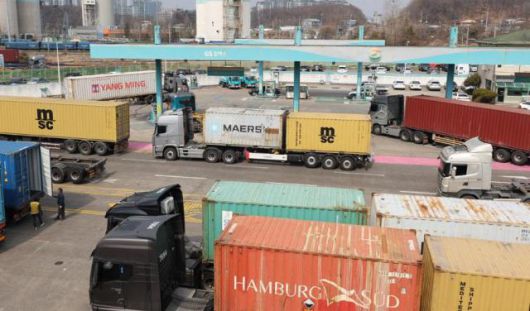
Cargo vehicles and trucks line up at a gas station in Uiwang, Gyeonggi Province, March 9, 2026. Yonhap |
<이미지를 클릭하시면 크게 보실 수 있습니다> |
The Korea Institute for Industrial Economics and Trade (KIET) warned that ongoing tensions around the Strait of Hormuz, a critical chokepoint for roughly one-fifth of the world's oil supply, have already pushed oil prices higher, and further escalation there could intensify supply disruptions and inflationary pressures on South Korea's energy‑intensive industries.
Oil prices have jumped sharply since U.S.‑led airstrikes on Iran late last month, as the conflict has escalated into a broader regional war with the U.S. vowing further strikes and Iran responding with retaliatory attacks.
Dubai crude oil has risen more than 40 percent, to about US$103 a barrel from around $72 before the fresh conflict began in the already volatile region. With Middle Eastern crude accounting for about 70 percent of South Korea's oil imports, and most shipments passing through the strategically important Strait of Hormuz, cost pressures on the country are intensifying further.
Exporters also face uncertainty. South Korea's shipments to the Middle East have grown steadily since 2020, though the region accounts for just about three percent of total exports. Even so, the institute warned that shipping disruptions could hit exporters directly or indirectly through higher freight costs, delivery delays, and broader supply chain disruptions.
The institute called for steps to stabilize energy supply chains through various measures including diversifying import sources and tapping strategic oil reserves, given South Korea's heavy reliance on Middle Eastern crude and liquefied petroleum gas.
"If the rise in global oil prices is prolonged, higher manufacturing costs and mounting price pressures could fuel inflation and raise the possibility of stagflation," said Hong Seong‑uk, the KIET's head.
Kim Seong-seo 기자 biblekim@ajunews.com
- Copyright ⓒ [아주경제 ajunews.com] 무단전재 배포금지 -
이 기사의 카테고리는 언론사의 분류를 따릅니다.
기사가 속한 카테고리는 언론사가 분류합니다.
언론사는 한 기사를 두 개 이상의 카테고리로 분류할 수 있습니다.
언론사는 한 기사를 두 개 이상의 카테고리로 분류할 수 있습니다.
