

 |
<이미지를 클릭하시면 크게 보실 수 있습니다> |
South Korea’s four major commercial banks have been tightening corporate debt guarantees as rising tariffs and a prolonged high exchange rate increase financial risks for businesses.
Although the overall volume of guarantees continued to grow, the pace of increase slowed significantly, reflecting banks’ more cautious stance amid worsening trade conditions and declining corporate resilience.
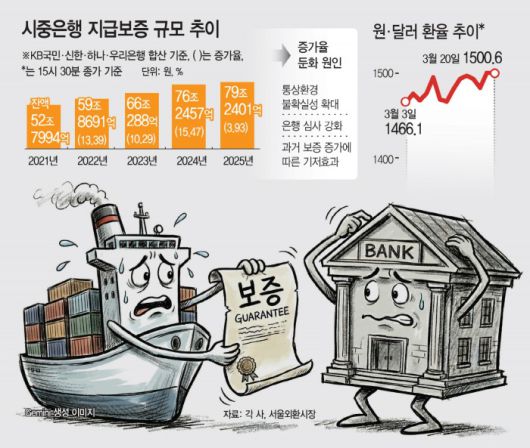
According to financial industry data on March 22, KB Kookmin, Shinhan, Hana, and Woori Bank held a combined 79.24 trillion won in payment guarantees as of the end of last year, up 3.93% from 76.25 trillion won a year earlier.
Of the total, confirmed guarantees—where banks assume fixed liabilities—rose 8.5% to 60.95 trillion won, while unconfirmed guarantees fell 8.8% to 18.29 trillion won.
Payment guarantees are contracts in which banks assure repayment of corporate obligations. Companies use such guarantees to enhance creditworthiness and secure financing or complete transactions, while banks earn fee-based, non-interest income. These guarantees are commonly used by export-import firms, with banks obligated to repay debts if companies default or encounter trade issues.
In recent years, guarantee volumes had surged alongside strong export growth, rising from 52.8 trillion won in 2021 to over 66 trillion won in 2023, with double-digit annual growth. However, growth slowed sharply last year to just 3.93%, roughly one-third of the previous year’s pace.
The slowdown is largely attributed to heightened uncertainty in the global trade environment. U.S. tariff policies on key Korean exports have raised concerns over profitability among exporters, prompting banks to focus on safer transactions and adopt more conservative guarantee practices.
Banks also reduced unconfirmed guarantees by 1.77 trillion won last year, either converting them into confirmed guarantees or cutting new issuance due to higher risk management complexity.
A base effect from previous rapid growth also played a role. While exports reached record levels last year, the growth rate slowed significantly, and rising corporate delinquency rates increased the need for stricter financial soundness management.
“Exports grew mainly among large corporations, many of which do not necessarily require bank guarantees,” a banking industry official said. “Both tighter risk management by banks and weaker demand from companies likely contributed.”
The outlook for this year remains subdued. Prolonged instability in the Middle East is expected to weigh on exports, while global logistics risks are intensifying. The Korean won weakening beyond 1,500 per dollar adds further pressure.
Since many guarantees are denominated in foreign currencies such as the U.S. dollar, a continued rise in the exchange rate could increase the outstanding guarantee balance even without new issuance, raising the burden on banks.
Do Won-bin, a senior researcher at the Korea International Trade Association, warned that prolonged high exchange rates could significantly erode corporate profitability.
“Extended currency weakness will increase production costs across industries, offsetting short-term export gains and potentially hurting up to 80% of companies,” he said. “Strengthening trade finance support, such as working capital and maturity extensions, is essential to contain risks.”
ⓒ "젊은 파워, 모바일 넘버원 아시아투데이"
이 기사의 카테고리는 언론사의 분류를 따릅니다.
기사가 속한 카테고리는 언론사가 분류합니다.
언론사는 한 기사를 두 개 이상의 카테고리로 분류할 수 있습니다.
언론사는 한 기사를 두 개 이상의 카테고리로 분류할 수 있습니다.
