

 |
<이미지를 클릭하시면 크게 보실 수 있습니다> |
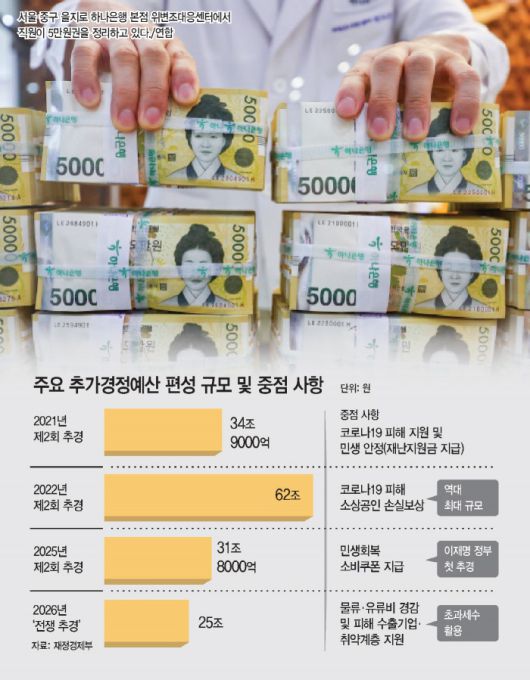
The South Korean government is moving swiftly to draft a so-called “war supplementary budget” to counter rising economic risks stemming from prolonged tensions in the Middle East, amid concerns that growth could fall to the 1% range.
According to government ministries on March 24, the extra budget is expected to include measures to ease the burden of high oil prices, stabilize energy supply chains, and minimize industrial damage caused by geopolitical uncertainty.
The supplementary budget, estimated at around 25 trillion won ($18.8 billion), aims to cushion the domestic economy from instability triggered by escalating tensions between the United States and Iran. Earlier projections had placed the 규모 at 15 trillion to 20 trillion won, but it has since been expanded. The government plans to fund the package using higher-than-expected tax revenues, avoiding additional government bond issuance.
While primarily designed to counter an economic slowdown, the budget is also expected to support a wide range of sectors, including youth employment programs. The Ministry of Economy and Finance emphasized targeted and differentiated support, prioritizing small business owners, low-income households, farmers, and regional economies.
During a confirmation hearing on March 23, finance minister nominee Park Hong-keun said, “One of the goals of the supplementary budget is to respond to mass youth unemployment.”
With Middle East instability raising downside risks, analysts warn that South Korea’s economic growth—currently projected at 2.0% by both the government and the Bank of Korea—could drop into the 1% range if the crisis persists.
The Finance Ministry also highlighted “downside risks” for the first time in eight months in its March economic report, stressing the need for swift fiscal action to mitigate the impact of external shocks.
However, economists caution that the supplementary budget could fuel inflation. With this year’s government budget already at a record 728 trillion won, additional fiscal spending may increase liquidity and push up prices.
The ministry had previously forecast a 2.1% rise in consumer prices for 2026, assuming declining global oil prices. But continued energy market volatility, combined with increased domestic demand from the supplementary budget, could drive inflation higher than expected.
Kim Jung-sik, professor emeritus of economics at Yonsei University, warned that even without issuing new bonds, the additional budget could raise aggregate demand and exert upward pressure on prices.
Still, many experts argue that swift action is necessary given the severity of the situation. Joo Won, head of research at Hyundai Research Institute, said concerns over inflation should be seen as secondary, adding that persistent high oil prices themselves pose a greater inflationary risk.
Park Jin, a professor at the Korea Development Institute (KDI), also noted that while the budget may contribute to inflation, it remains a necessary tool to prevent an economic downturn. He emphasized that support should focus on low-income groups and industries most affected by the Middle East crisis.
ⓒ "젊은 파워, 모바일 넘버원 아시아투데이"
이 기사의 카테고리는 언론사의 분류를 따릅니다.
기사가 속한 카테고리는 언론사가 분류합니다.
언론사는 한 기사를 두 개 이상의 카테고리로 분류할 수 있습니다.
언론사는 한 기사를 두 개 이상의 카테고리로 분류할 수 있습니다.
