

 |
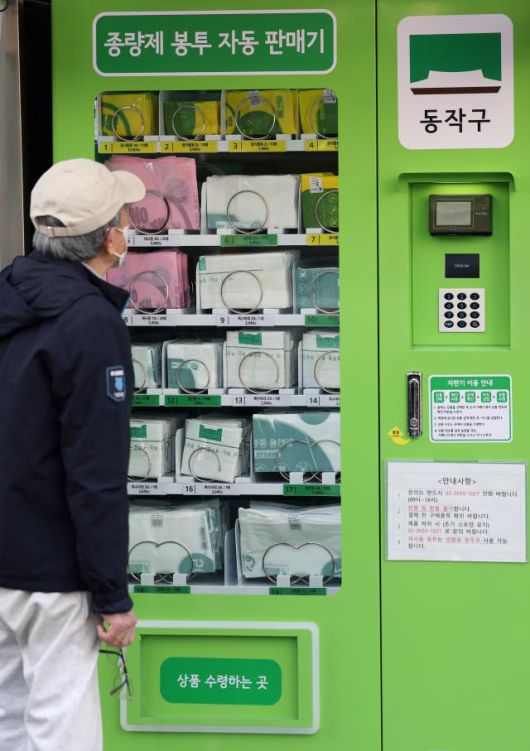
With supply disruptions in petrochemical products such as naphtha — a key raw material for plastics and vinyl — intensifying due to the Middle East crisis, Jongnyangje.com, a distributor of government-issued garbage bags, said on its website that production, supply and delivery schedules for the bags have been facing difficulties. The photo shows a garbage bag vending machine in Seoul on March 24, 2026. (Yonhap) |
<이미지를 클릭하시면 크게 보실 수 있습니다> |
The composite consumer sentiment index (CCSI) stood at 107.0 in March, down 5.1 points from the previous month, according to the Bank of Korea. The reading marked the lowest level since 101 recorded in May 2025 and the sharpest drop since December 2024, when a short-lived martial law declaration rattled markets and public sentiment.
The CCSI is a composite gauge of consumer perceptions, combining six sub-indices that track current living standards, household income and spending outlook, and broader economic conditions. A reading above 100 indicates optimism relative to the long-term average from 2003 to 2024, while a reading below 100 signals pessimism.
The latest decline reflects mounting anxiety over energy supply disruptions stemming from the ongoing conflict in the Middle East. Since late February, joint U.S.-Israel strikes on Iran have disrupted the Strait of Hormuz — a critical chokepoint through which roughly one-fifth of global energy shipments pass — while also forcing a suspension of some Qatari gas flows.
The shock is particularly acute for South Korea, which relies heavily on the region for energy imports. According to the Korea International Trade Association, 68.8 percent of Korea’s crude oil imports and 19.7 percent of its natural gas imports came from the Middle East in 2025.
Sub-indices showed a broad-based deterioration in sentiment. The index measuring current economic conditions plunged 9 points to 86, while the outlook for the economy over the next six months dropped a steeper 14 points to 89, underscoring growing concerns over the war’s spillover effects.
Income-related indicators also weakened. The index for current household income fell 3 points to 97, slipping into pessimistic territory, while the outlook for future income edged down 2 points to 101.
Inflation expectations ticked higher. The perceived current inflation rate was at 2.9 percent, while expected inflation for the next 12 months increased by 0.1 percentage point to 2.7 percent, marking the first uptick in five months.
The housing price outlook index dropped 12 points to 96, falling below the neutral 100 mark for the first time in 13 months since February 2025, extending a sharp 16-point decline in the previous month amid tightening property regulations.
The index suggests that more respondents now expect home prices to decline over the next year than to rise, adding to signs of a broader cooling in domestic demand expectations.
Lee Jung-woo 편집국장 cannes2030@ajupress.com
- Copyright ⓒ [아주경제 ajunews.com] 무단전재 배포금지 -
이 기사의 카테고리는 언론사의 분류를 따릅니다.
기사가 속한 카테고리는 언론사가 분류합니다.
언론사는 한 기사를 두 개 이상의 카테고리로 분류할 수 있습니다.
언론사는 한 기사를 두 개 이상의 카테고리로 분류할 수 있습니다.
