

 |
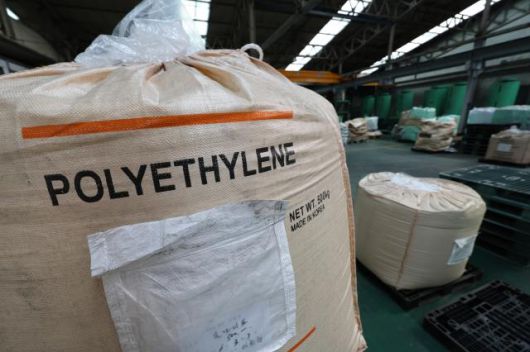
지난 24일 경기 안산시의 한 플라스틱 필름 제조 공장 내 원료창고에 폴리에틸렌 등 원료가 쌓여 있어야 할 원료창고가 듬성듬성 비어있다. |
<이미지를 클릭하시면 크게 보실 수 있습니다> |
The Ministry of Trade, Industry and Energy on midnight Friday issued a gazette enforcing ban on naphtha exports immediately for five months as a part of a package of "wartime" measures that included deeper and longer cuts to fuel tax and supplementary budget.
Naphtha is an essential feedstock for producing petrochemical materials used by industries including semiconductors and autos.
South Korea relies on imports for 45 percent of domestic demand, and supplies from the Middle East — which account for 77 percent of imports — have been disrupted by the war, the ministry said.
The government previously supported efforts to secure alternative import sources, including those from Russia after Washington lifted some sanctions, and designated naphtha as an economic security item, making it eligible for low-interest financing through a supply chain fund.
As the situation dragged on, it moved to stronger steps, including shifting restricted export volumes to the domestic market and banning hoarding.
Under the notice, exports of all naphtha are restricted in principle, with exceptions allowed only with approval from the industry minister.
Naphtha businesses (refiners) and users (petrochemical companies) must report daily to the ministry on production, imports, use, sales and inventories.
Hoarding is prohibited. If a naphtha business’ weekly shipment ratio drops by more than 20 percent from 2025 without a reasonable explanation, the minister can order steps such as adjusting sales and inventories.
The government can also order refiners to produce naphtha and take supply-adjustment measures to ensure naphtha produced domestically or brought in from overseas is supplied to specific petrochemical companies.
According to industry minister Kim Jung-kwan, “Because naphtha is a basic raw material that supports South Korea’s industry, the government will secure as much volume as possible through support for overseas procurement.”
He urged cooperation so that naphtha and related petrochemical products are distributed and managed in line with the purpose of the new notice.
“The government will supply naphtha as a top priority so there is no impact on health care, key industries and the production of essential goods,” Kim added.
The emergency step comes as supply disruptions have already begun to hit production lines. One of the country’s largest naphtha cracking centers has been forced to halt operations due to feedstock shortages, according to industry sources, amplifying concerns over a broader shutdown across the petrochemical chain.
The shock is cascading into everyday goods. Plastic processors and packaging firms are reporting delays in securing raw materials, while distributors warn of tightening supplies of garbage bags and industrial films, echoing early signs of hoarding in retail channels.
Seoul is also weighing more controversial options to plug the supply gap. Officials said the government is in talks with industry players over the possibility of resuming imports of Russian crude oil and naphtha, a move that would require easing sanctions imposed after Moscow’s invasion of Ukraine.
South Korea halted Russian crude imports in December 2022, though the country previously relied on Russia for about 5.6 percent of its crude supply. Since then, dependence on the Middle East has deepened, leaving the economy more exposed to disruptions around the Strait of Hormuz — a chokepoint through which roughly 70 percent of the country’s crude and about half of its naphtha imports pass.
Finance Minister Koo Yun-cheol earlier signaled the shift toward more interventionist policy, describing the export curb and stockpiling controls as necessary to stabilize supply chains under what the government views as wartime conditions.
Whether the measures can fully contain the fallout remains uncertain. Without a de-escalation in the Middle East, industry officials warn that shortages could persist, raising the risk of prolonged disruptions not only in petrochemicals but across manufacturing sectors that rely on plastic and synthetic materials as foundational inputs.
Kim Seong-seo 기자 biblekim@ajunews.com
- Copyright ⓒ [아주경제 ajunews.com] 무단전재 배포금지 -
이 기사의 카테고리는 언론사의 분류를 따릅니다.
기사가 속한 카테고리는 언론사가 분류합니다.
언론사는 한 기사를 두 개 이상의 카테고리로 분류할 수 있습니다.
언론사는 한 기사를 두 개 이상의 카테고리로 분류할 수 있습니다.
