

 |
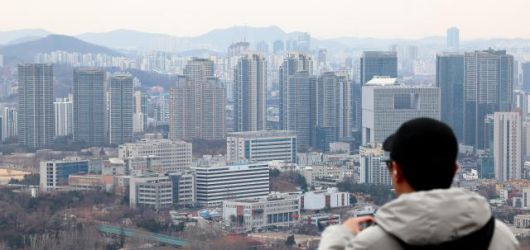
This undated photo shows a cluster of corporate office buildings and apartment complexes in the Yongsan District of central Seoul. Yonhap. |
<이미지를 클릭하시면 크게 보실 수 있습니다> |
According to the Bank of Korea on Friday, the all-industry composite business sentiment index (CBSI) stood at 94.1 in March, down 0.1 point from the previous month. A reading below 100 means pessimists outnumber optimists.
The reading also fell far short of the BOK's February projection of 97.6, missing the forecast by 3.6 points.
Manufacturing sentiment was unchanged at 97.1, but still below the expected 98.9. More worrying was the outlook for April, which fell 3 points to 95.9, the steepest monthly drop in 14 months since January 2025.
The deterioration was more pronounced among small and medium-sized enterprises. While the outlook for large firms edged down 0.9 point to 98.7, sentiment among SMEs plunged 2.7 points, underscoring their greater vulnerability to rising costs and supply-chain disruptions.
The BOK said gains of 0.6 point each in production and new orders were offset by a 0.6-point drop in inventory conditions and a 0.4-point decline in funding conditions.
The data also showed a widening gap between exporters and domestic-oriented firms. Sentiment among exporters rose 1.2 points to 103.1, staying above 100 for a third straight month. By contrast, sentiment among import-reliant domestic businesses stood at just 94.5.
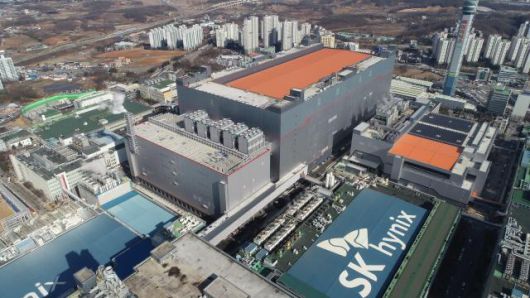 |
This undated photo shows the SK hynix Icheon Campus. Courtesy of SK hynix. |
<이미지를 클릭하시면 크게 보실 수 있습니다> |
Non-manufacturing sentiment stood at 92.0, well below the February projection of 96.8, while the April outlook came in even lower at 91.2. Services were hit particularly hard, with the transportation and warehousing sector posting a CBSI of 93.4, far below the earlier projection of 99.
"The blockade of the Strait of Hormuz has caused major disruptions in global logistics, dealing a severe blow to the transportation and warehousing sectors," Lee said.
Among manufacturers, the most frequently cited business difficulty was "uncertain economic conditions," at 22.1 percent, up 2.8 percentage points from the previous month. Concern over rising raw material prices more than doubled to 21.0 percent, reflecting higher energy and commodity costs linked to the conflict. While weak domestic demand remained a major complaint at 19.0 percent, it lost its position as the top concern from February's 24.6 percent as geopolitical risks moved to the forefront.
The broader economic sentiment index (ESI), which combines business and consumer confidence, fell 4.8 points to 94.0, wiping out all gains made in February and marking the sharpest drop since September 2023.
Still, the ESI cyclical indicator — which strips out seasonal and irregular external shocks — edged up 0.4 point to 96.6, suggesting the underlying trend may have improved absent the sudden geopolitical escalation.
The survey was conducted from March 12 to 19 among 3,524 companies nationwide, with responses from 3,223 firms, including 1,799 manufacturers and 1,433 non-manufacturers.
Kim Yeon-jae Reporter duswogmlwo77@ajupress.com
- Copyright ⓒ [아주경제 ajunews.com] 무단전재 배포금지 -
이 기사의 카테고리는 언론사의 분류를 따릅니다.
기사가 속한 카테고리는 언론사가 분류합니다.
언론사는 한 기사를 두 개 이상의 카테고리로 분류할 수 있습니다.
언론사는 한 기사를 두 개 이상의 카테고리로 분류할 수 있습니다.
