

 |
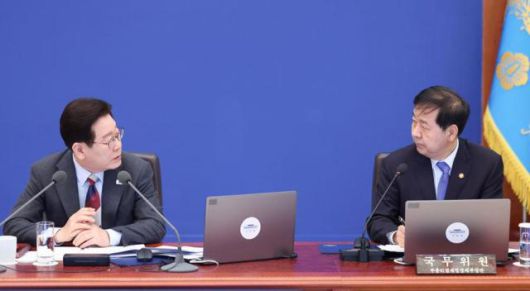
President Lee Jae Myung (left) talks with Deputy Prime Minister and Finance Minister Koo Yoon-cheol during a Cabinet meeting at Cheong Wa Dae in Seoul on March 5, 2026. Yonhap |
<이미지를 클릭하시면 크게 보실 수 있습니다> |
SEOUL, March 5 (AJP) - The government will crack down on price collusion and other unfair practices, and strict measures will be taken against any violations, Deputy Prime Minister and Finance Minister Koo Yoon-cheol said on Thursday.
His remarks came as domestic fuel prices were already surging even before the impact of escalating tensions in the Middle East caused by last week's U.S.-led airstrikes against Iran under the military operation dubbed "Operation Epic Fury" was fully felt in the local market.
Speaking at an emergency Cabinet meeting chaired by President Lee Jae Myung at Cheong Wa Dae, Koo said "We are seeing an excessive hike in gasoline and other petroleum prices," vowing to conduct intensive inspections to punish any collusion and implement corrective measures in cooperation with relevant industries.
Koo said energy prices had climbed approximately 13 percent as of early Thursday morning, outlining contingency measures that include securing energy supplies beyond the Middle East, exercising pre-emptive purchase rights and tapping strategic oil reserves if necessary.
Turning to the broader economic fallout, Koo said that about 49 small and medium-sized exporters had reported difficulties including shipping disruptions, delayed payments, and rising logistics costs. To support them, the government plans to provide 20.3 trillion Korean won (US$14 billion) in funding through interest rate cuts and expanded loans, along with tax relief measures for affected firms.
Lee then ordered the immediate injection of 100 trillion won ($68.3 billion) into capital and financial markets to counter the fallout from the Middle East conflict. "Our first priority must be to actively address the increased market volatility across financial sectors, including equities and exchange rates," he said.
If the Middle East conflict drags on and disrupts oil shipments through the Strait of Hormuz, a critical chokepoint for roughly one‑fifth of the world's oil supply, the government will help cover rising freight costs and deploy emergency response teams to monitor supply chains for goods heavily dependent on the perennially volatile region.
Some 38 South Korean vessels are currently operating in and around the strategically vital waterway including 26 within the strait itself, with no incidents or damage reported so far.
Meanwhile, Foreign Minister Cho Hyun said that a total of 18,472 South Korean nationals including some 4,935 short-term visitors, are currently in 14 Middle Eastern countries.
Regarding their safety, Cho said, "There have been no casualties among our nationals so far," adding that evacuations to neighboring countries have been carried out with support from local diplomatic missions.
Lee urged ministers to respond swiftly and thoroughly, stressing that the safety of South Korean nationals overseas should be treated as a matter of utmost priority.
Park Ki-rock 기자 kirock@ajunews.com
- Copyright ⓒ [아주경제 ajunews.com] 무단전재 배포금지 -
이 기사의 카테고리는 언론사의 분류를 따릅니다.
기사가 속한 카테고리는 언론사가 분류합니다.
언론사는 한 기사를 두 개 이상의 카테고리로 분류할 수 있습니다.
언론사는 한 기사를 두 개 이상의 카테고리로 분류할 수 있습니다.
