

 |
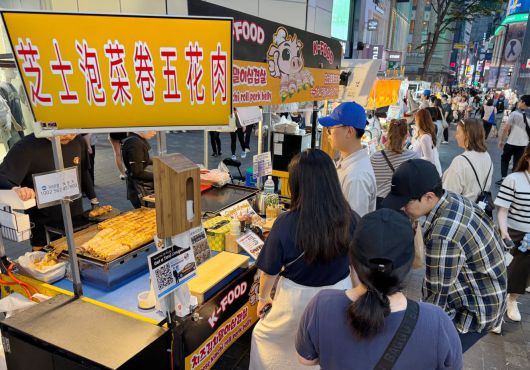
Visitors gather in front of a street stall with Chinese signs in Seoul’s Myeong-dong shopping district on May 22. /Jang Kyung-sik |
<이미지를 클릭하시면 크게 보실 수 있습니다> |
Shouts of “Tanghulu haochi, so delicious” and “Zhenhaokan, so pretty” echoed along the main street of Myeong-dong in central Seoul at 8 p.m. on June 7, where more than 220 stalls stretched nearly 500 meters. The street resembled a Chinese night market, with Chinese part-time workers singing Korean songs rewritten in Mandarin and calling out to passersby in Chinese, “Cheap, cheap!” Many workers said the actual stall owners rarely appeared. “The boss doesn’t come out. I open and close the stall myself,” several told the Chosun Ilbo.
Since 2016, Seoul’s Jung District has operated a street stall permit system intended to support small-scale livelihood vendors and curb large-scale business-style operations. For an annual fee of about 900,000 won, vendors receive road use permits with conditions that include one stall per person, personal operation, and alternate-day schedules.
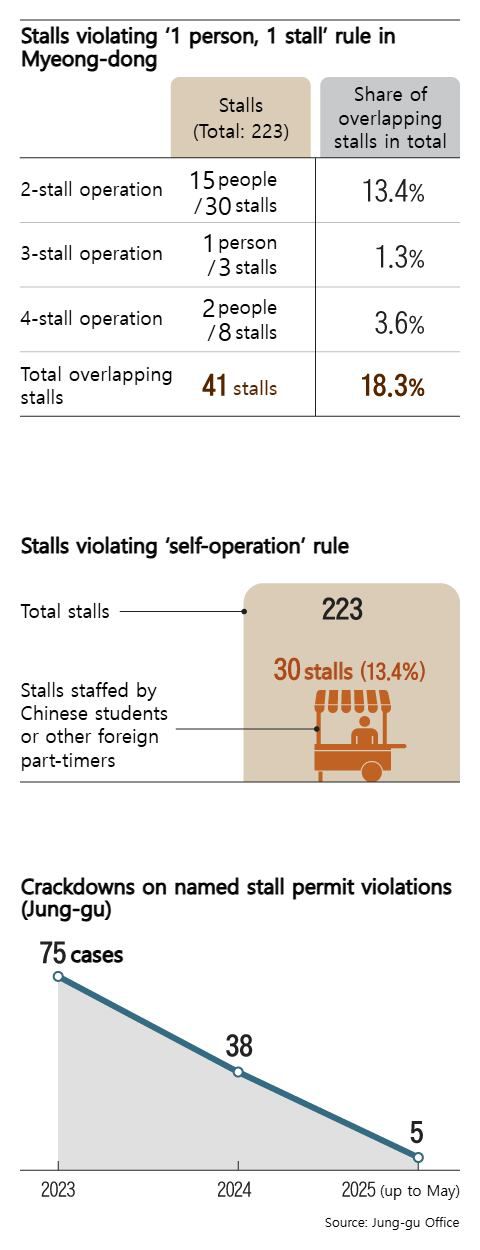
As of this year, 348 stalls are registered in the district. Based on the alternate-day rule, only 174 should operate on a given day. However, a recent survey found 223 stalls active in the Myeong-dong shopping district. Among them, 30 were run by hired workers without the owner present, and 19 were staffed by foreign part-time workers, mostly Chinese nationals.
The Chosun Ilbo cross-checked bank account numbers and account holder names posted for cash transfers at the stalls. It found 41 stalls (18.3%) sharing the same account holder name across two or more locations, with some names linked to as many as four stalls. Vendors usually kept payment signs hidden and only showed them briefly during transactions to conceal the account holder’s identity.
 |
Graphics by Lee Jin-young |
When asked how to start operating a stall, 10 vendors said, “Outsiders can’t join.” They added, “You need an introduction.” A vendor with 10 years of experience said, “We don’t hand stalls to strangers. Only close family or friends, usually for a fee.” Nearby shop owners familiar with the Myeong-dong stalls said, “They pay only 900,000 won a year in road fees to the district but earn tens of times more.” They added that a “street stall cartel” has formed, dominated by a few vendors earning over 100 million won annually.”
In response to complaints about price gouging, forced cash payments, and poor service, Jung-gu office registered about 80% of Myeong-dong stalls as official businesses last year and required them to install card readers. At the time, district officials said the move was intended to “restore the reputation of Myeongdong as South Korea’s premier tourist destination and rebuild public trust.”
However, when reporters visited Myeongdong-gil on the evening of May 29 and surveyed all 223 stalls in operation, 55 (roughly 25 percent) said they only accepted cash. Even among those with credit card machines, many required a minimum purchase of 10,000 won. At one food stall, when a customer ordered 9,000 won worth of tteokbokki and fish cake skewers and tried to pay with a card, the vendor refused and pointed to a bank account sign, saying, “No cards—transfer the money.”
Under current regulations, registered vendors are required to operate their stalls in person after receiving road-use permits. However, interviews with vendors and local real estate agents revealed an underground market in which stall locations are being transferred for sums ranging from 100 million to 200 million won or subleased for monthly rents between 1.5 million and 3 million won. In many cases, registered owners lease out stalls to tenants, who then hire foreign part-timers to run them, creating a multi-layered chain of operations.
The growth of corporate-style vendors—where one person manages multiple stalls—has triggered backlash from nearby storefront businesses. One real estate agent said restaurant owners have complained, saying, “We pay full taxes, but these vendors do business in cash and only pay a 900,000-won road fee. It’s a completely unfair game.”
The increasing number of stalls operating in violation of the alternate-day rule has also intensified pedestrian congestion. Enforcement has waned, with only five violations recorded as of May this year, down from 75 in 2023. Critics say the district’s crackdown is largely symbolic. One real estate worker in Myeongdong recalled, “Last spring, when patrols carrying glow sticks made their rounds, vendors who rarely showed up suddenly appeared, and people started asking each other, ‘Wait, are you the stall owner?’”
Dongdaemun District, which introduced its own real-name vendor registration system in 2020, began deploying special judicial police officers in 2022. Over the past three years, they have removed 233 of the 572 stalls in the area. Among these, 69 (29.6%) were officially licensed by Seoul or the district office but were shut down for violating direct-operation rules or being run as corporate-style businesses.
Dongdaemun District initially faced the same issues as Myeongdong, including ownership transfers and one person operating multiple booths. Even when city officials asked vendors for ID to verify compliance, many refused, saying, “You don’t have the authority.” In response, the district appointed seven staff members as special judicial police and assigned them to designated areas. These officers now conduct regular inspections, cross-referencing the operators’ personal information and operation histories to identify unauthorized leasing, ownership transfers, and other violations of the real-name system.
[Cho Min-hee]
- Copyrights ⓒ 조선일보 & chosun.com, 무단 전재 및 재배포 금지 -
이 기사의 카테고리는 언론사의 분류를 따릅니다.
기사가 속한 카테고리는 언론사가 분류합니다.
언론사는 한 기사를 두 개 이상의 카테고리로 분류할 수 있습니다.
언론사는 한 기사를 두 개 이상의 카테고리로 분류할 수 있습니다.
