

 |
[사진=연합뉴스] |
<이미지를 클릭하시면 크게 보실 수 있습니다> |
The producer price index (PPI) rose 0.3 percent from the previous month to 121.31 in November (2020 = 100), extending gains since September, the Bank of Korea said. From a year earlier, the index increased 1.9 percent, accelerating from a 1.6 percent rise in October.
By category, prices of agricultural products fell 2.3 percent, while livestock products declined 2.6 percent, pulling the broader agriculture, forestry and fisheries group down 2.1 percent on the month. Lettuce prices plunged 42.7 percent, while beef prices fell 4.6 percent and pork prices dropped 4.1 percent.
Prices of manufactured products climbed 0.8 percent from the previous month, led by coal and petroleum products, which jumped 5 percent — the largest increase since September 2023. Production prices for computers, electronic and optical equipment rose 2.3 percent, reflecting sharp increases in semiconductor costs.
Prices of DRAM surged 15.5 percent on the month and 67.9 percent from a year earlier, while flash memory prices rose 23.4 percent on the month and 58.2 percent on the year.
The increase reflects the broad impact of the won’s weakness on imported inputs and fuel costs, combined with rapid strengthening in memory prices amid tight supply conditions. The trend is expected to ripple through end products, including electronic devices and automobiles, both of which rely heavily on memory components.
The domestic supply price index for November, which includes imports, rose 0.7 percent from the previous month. Intermediate goods prices climbed 1.1 percent and final goods rose 0.2 percent, offsetting a 0.5 percent decline in raw material prices.
The total output price index for November, which includes exports as well as domestic shipments, increased 1.1 percent from the previous month, as manufactured products rose 1.9 percent and services edged up 0.1 percent.
 |
Graphics by Song Ji-yoon |
<이미지를 클릭하시면 크게 보실 수 있습니다> |
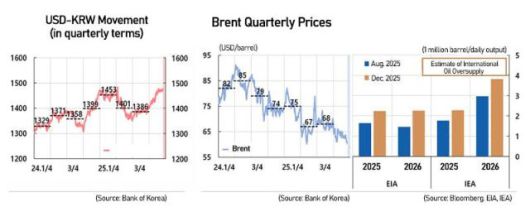
A weaker won against the U.S. dollar raises domestic production costs by making imported raw materials and intermediate goods more expensive, indirectly pushing up producer prices, the central bank said. The timing and extent of pass-through to producer prices can vary depending on business conditions, supply and demand, and government price-stabilization measures, it added.
So far in December, Dubai crude prices have fallen 3.1 percent from the previous month, while the dollar-won exchange rate has risen 0.9 percent.
In a separate report released Wednesday, the Bank of Korea warned that inflation could rise above this year’s estimated 2.1 percent level if the exchange rate remains near 1,500 won per dollar, given the two-to-four-week lag in the pass-through to consumer prices.
It added the oversupply and soft international fuel prices will likely offset the inflationary pressure from the won's weakness.
Kim Yeon-jae 기자 duswogmlwo77@ajupress.com
- Copyright ⓒ [아주경제 ajunews.com] 무단전재 배포금지 -
이 기사의 카테고리는 언론사의 분류를 따릅니다.
기사가 속한 카테고리는 언론사가 분류합니다.
언론사는 한 기사를 두 개 이상의 카테고리로 분류할 수 있습니다.
언론사는 한 기사를 두 개 이상의 카테고리로 분류할 수 있습니다.
