

 |
A series of legislative moves by the ruling Democratic Party of Korea has sparked controversy, with critics warning that the bills could undermine the separation of powers and interfere with ongoing criminal trials involving President Lee Jae-myung.
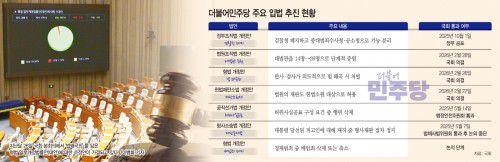
The legislative push — including proposals to expand the number of Supreme Court justices, introduce a constitutional complaint system against court rulings, and abolish the crime of breach of trust — has prompted accusations that the National Assembly is attempting to reshape laws in ways that could affect judicial outcomes.
Legal experts have raised concerns that the efforts amount to what they call the “privatization of legislation,” arguing that the bills appear closely tied to several criminal cases involving the president.
According to political sources, the Democratic Party’s newly formed committee investigating what it calls “fabricated prosecutions” under the previous administration plans to submit a request for a parliamentary probe during the current extraordinary session of the National Assembly.
The committee aims to examine several high-profile cases involving figures from the ruling bloc, including the Daejang-dong development scandal, the Ssangbangwool remittance case to North Korea, and the West Sea public official shooting incident.
At the same time, the party has urged prosecutors to withdraw indictments related to President Lee’s cases, arguing that the investigations were politically motivated.
The Democratic Party has also pushed forward major institutional reforms targeting the prosecution service. A government reorganization bill abolishing the prosecution service and separating investigative and prosecutorial powers was recently passed by the National Assembly. Lawmakers also approved revisions allowing the justice minister to request disciplinary action against prosecutors and adding dismissal as a new disciplinary penalty.
Attention has also focused on the party’s so-called “three judicial reform bills,” which were swiftly passed in late February. The package includes legislation expanding the number of Supreme Court justices from 14 to as many as 26, introducing a constitutional complaint system allowing the Constitutional Court to review final court rulings, and creating a new criminal offense punishing judges or prosecutors who distort the law in ways that affect trial outcomes.
Although the ruling party says the reforms are intended to dismantle what it calls an overly centralized judicial structure, critics in legal circles argue the measures could weaken judicial independence.
Some observers have suggested the legislation could also influence several ongoing cases involving President Lee. These include appeals related to violations of the Public Official Election Act, corruption allegations tied to the Daejang-dong and Baekhyeon-dong development projects, misuse of a Gyeonggi provincial government corporate card, alleged illegal remittances to North Korea through Ssangbangwool Group, and charges of suborning perjury.
Proposed amendments to the Public Official Election Act, which would remove certain forms of false statements from the definition of punishable offenses, could potentially affect the election law case currently under retrial.
Meanwhile, debate over the abolition of breach of trust — a key charge in several corruption cases — has intensified. If the offense were removed from the criminal code, legal experts say some cases could be dismissed under provisions that require courts to drop charges when the underlying crime is abolished by law.
The Democratic Party had also considered legislation late last year to suspend criminal trials involving a sitting president, but the proposal was shelved after objections from the presidential office at the time.
Critics warn that such legislative actions risk being perceived as attempts to influence the judiciary.
“Court verdicts should be decided in the courtroom,” said a former senior prosecutor now working as a lawyer. “Attempts by the National Assembly to change laws in ways that could alter the outcome of ongoing trials are a dangerous precedent.”
ⓒ "젊은 파워, 모바일 넘버원 아시아투데이"
이 기사의 카테고리는 언론사의 분류를 따릅니다.
기사가 속한 카테고리는 언론사가 분류합니다.
언론사는 한 기사를 두 개 이상의 카테고리로 분류할 수 있습니다.
언론사는 한 기사를 두 개 이상의 카테고리로 분류할 수 있습니다.
